
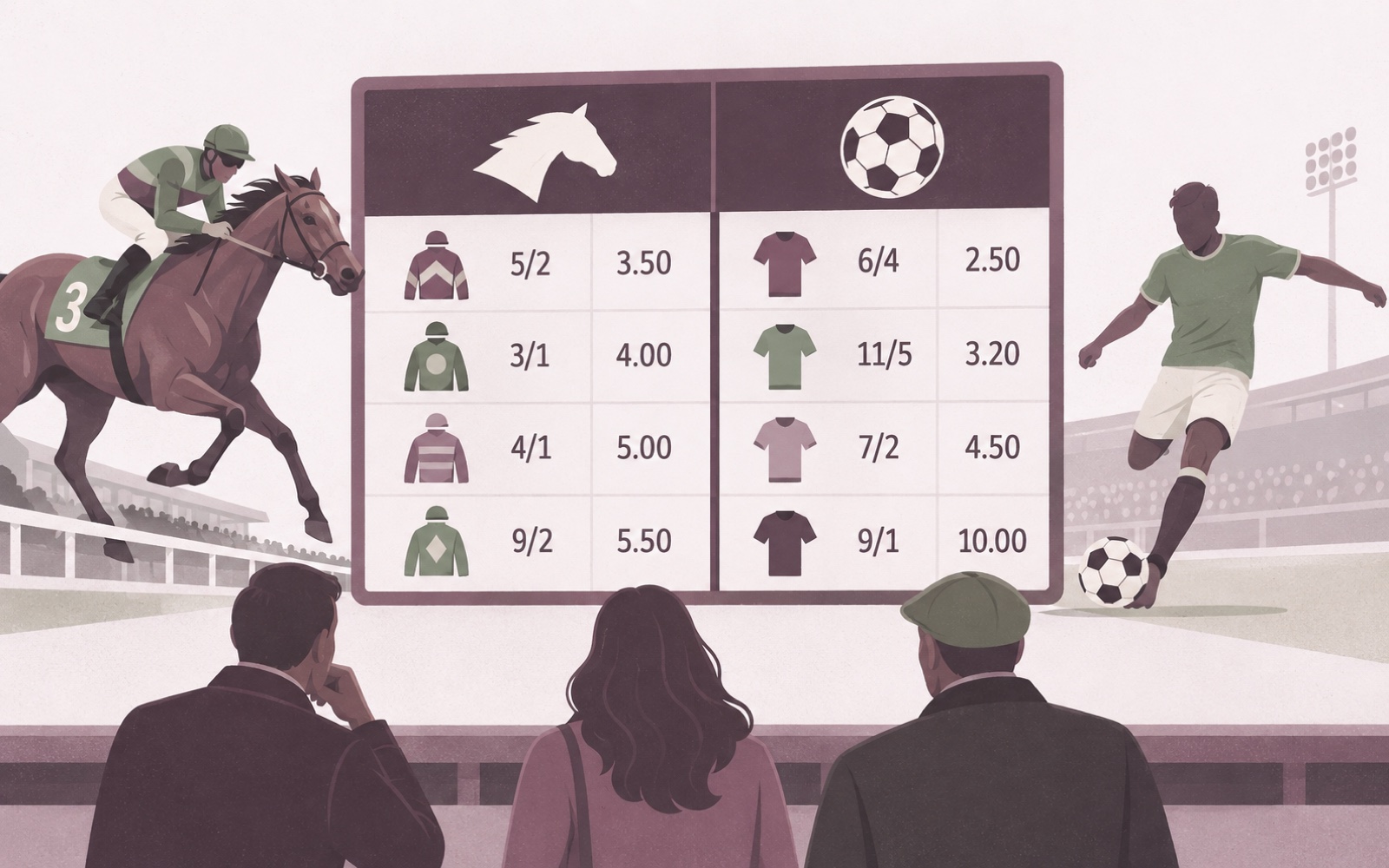
Odds can look like a puzzle to solve, and plenty of marketing encourages you to think that cracking them is the route to profit. It is not. Understanding odds is genuinely useful, but mainly because it makes the real cost of a bet visible, which in turn helps you keep stakes small and walk away when you planned to.
We explain the mechanics plainly and without hype. If betting has started to feel like a way to make money rather than an occasional flutter, that is worth taking seriously, and free confidential support is always available from the GamCare helpline on 0808 8020 133.
01
How betting odds are written and read
Odds express how likely an outcome is judged to be, and how much you would receive if it happened. In Britain you will see fractional odds such as 5/1 and decimal odds such as 6.0, which mean the same thing. At 5/1 a £10 stake returns £50 in winnings plus your £10 back; at 6.0 the £10 stake returns £60 in total, which is the same result described differently.
Reading a price as a probability is the useful skill. Odds of 5/1 imply roughly a one-in-six chance, or about 17 per cent. Seeing the number as a chance rather than a payout keeps your feet on the ground.
02
Fractional, decimal and why they are the same price
Fractional and decimal formats can be converted in a moment. To turn fractional into decimal, divide the first number by the second and add one, so 5/1 becomes 6.0 and 6/4 becomes 2.5. Nothing about the underlying value changes; only the presentation does. Pick whichever format you find easier to read and stick with it.
The reason this matters for safety is simple. When you can read a price instantly, you are less likely to be dazzled by a big-looking number and more likely to see the actual chance and the actual cost.
A common example
A price of 11/4 looks awkward but converts to 3.75, an implied chance of about 27 per cent. Once you see it as roughly a one-in-four shot, a large potential return stops looking like a likely one, which is exactly the perspective that keeps stakes modest.
03
The margin, or how the book is set in the site's favour
Add up the implied probabilities across every outcome in a market and they come to more than 100 per cent. That surplus is the margin, sometimes called the overround, and it is the site's built-in edge. A market whose implied chances total 105 per cent carries a margin of about 5 per cent, which on average the book keeps regardless of who wins any single bet.
This is the single most important fact on the page. The margin is why betting is a form of paid entertainment, not an income, and why the size of your stake matters far more than squeezing a slightly better price.
| What to check | Why it matters | Where |
|---|---|---|
| UKGC licence | Legal to serve UK, dispute route | Public register |
| Safer-gambling tools | Limits, time-outs, self-exclusion | Account settings |
| Payment terms | Debit only, clear withdrawal times | Banking page |
04
Comparing prices without letting it pull you in
Comparing odds between sites is reasonable, because a better price on the same outcome is more efficient. The risk is that price comparison quietly becomes a reason to open more accounts and bet more often, which increases exposure rather than value. Keep the habit in proportion, and remember that no comparison overcomes the margin over time.
If you find yourself hunting prices for hours or opening extra accounts to chase small edges, that is a behaviour worth watching. Our guide to choosing a site explains why more accounts usually means more risk.
Key points
- Odds are probability plus a margin, so betting is entertainment, never a reliable income.
- The margin, not the format of the odds, is what quietly costs you, so keep stakes small.
- If betting feels like a way to make money, take a break and talk to GamCare free on 0808 8020 133.
05
Markets, in-play and bet builders to treat with care
The range of markets has grown enormously, from match results to individual player statistics, in-play prices that shift by the second, and bet builders that combine several selections into one. These can be enjoyable, but they usually carry a larger margin and, more importantly, they invite fast and frequent betting, which is where control tends to slip.
Treat these features as entertainment with a fixed budget rather than as opportunities. A reality-check reminder helps you notice how long you have been playing, and a deposit limit keeps a lively session from turning into a costly one.
A common example
A five-leg bet builder can advertise a tempting return, but each added leg increases the site's cumulative edge and the chance of losing the whole bet. Enjoyed once in a while with a small stake, it is harmless fun; used repeatedly to chase a big return, it is a fast route to spending more than you meant to.
06
Value, discipline and staking within your limits
Discipline matters more than any theory of value. Decide the amount you are willing to lose before you look at a single price, treat it as the cost of an evening out, and stop when you reach it whether you are up or down. Level, modest stakes are far safer than schemes that tell you to increase your bet after a loss, which simply raise the amount at risk.
A good self-test is whether you would be comfortable telling someone you trust exactly what you staked and why. If the honest answer makes you uneasy, that discomfort is useful information.
07
Where promotions distort the real price
Promotions such as enhanced odds, price boosts and free bets can improve a single price, but their purpose is to increase how much and how often you bet, which usually outweighs the benefit. Read the conditions carefully, including maximum stakes, minimum odds and any wagering requirement, which since 19 January 2026 is capped at ten times the bonus with mixed product promotions banned.
The steadier approach is to decide whether you want to bet at all before an offer enters the picture. If you would not have placed the bet without the promotion, the promotion is steering you, and that is exactly the moment to slow down. Free self-assessment tools at BeGambleAware can help you check your own habits.
Related reading on this site
- Choosing a betting site, step by step
- Checking a site's UKGC licence
- Deposits, withdrawals and the credit ban
- Deposit limits, time-outs and GAMSTOP
- Spotting a site that is not safe
How we check our facts
This guide draws on rules and consumer guidance from the Gambling Commission, and on advice and self-assessment tools from GamCare. Bonus wagering rules were last checked on 25 September 2026.

Frequently asked questions
Do better odds mean I am more likely to win money over time?
No. Taking a better price on the same outcome is more efficient, but every market still carries a margin that works in the site's favour, so betting is not a way to make money over time. Odds reflect probability plus that margin, not a promise. The healthiest way to read a price is as the cost of a flutter you can afford to lose. If you are betting to win money back or to pay bills, please pause and call GamCare free on 0808 8020 133.
What is the overround and how does it affect me?
The overround, or margin, is the amount by which the implied probabilities in a market add up to more than 100 per cent. That extra slice is the site's built-in edge. If a market's implied chances total 105 per cent, the margin is roughly 5 per cent, and on average that is money the book keeps. It is why no staking pattern beats betting in the long run, and why keeping stakes small matters far more than chasing a fractionally better price.
Are bet builders and in-play markets riskier than a single bet?
They tend to carry a larger margin and they invite fast, frequent betting, which is where control most often slips. Combining several selections multiplies the site's edge, and in-play markets update quickly enough to encourage snap decisions. None of that makes them wrong to enjoy occasionally, but treat them as entertainment with a set budget, use a reality-check reminder, and never use them to try to recover a loss.
How do promotions like enhanced odds change the real value of a bet?
Enhanced odds and price boosts can genuinely improve a single price, but they are designed to increase how much and how often you bet, which usually outweighs the benefit. Read the conditions, including maximum stakes and any bonus wagering, which since 19 January 2026 is capped at ten times the bonus. The safest habit is to decide whether you want to bet before you see any offer, then judge the offer against that plan rather than letting it set the plan.