
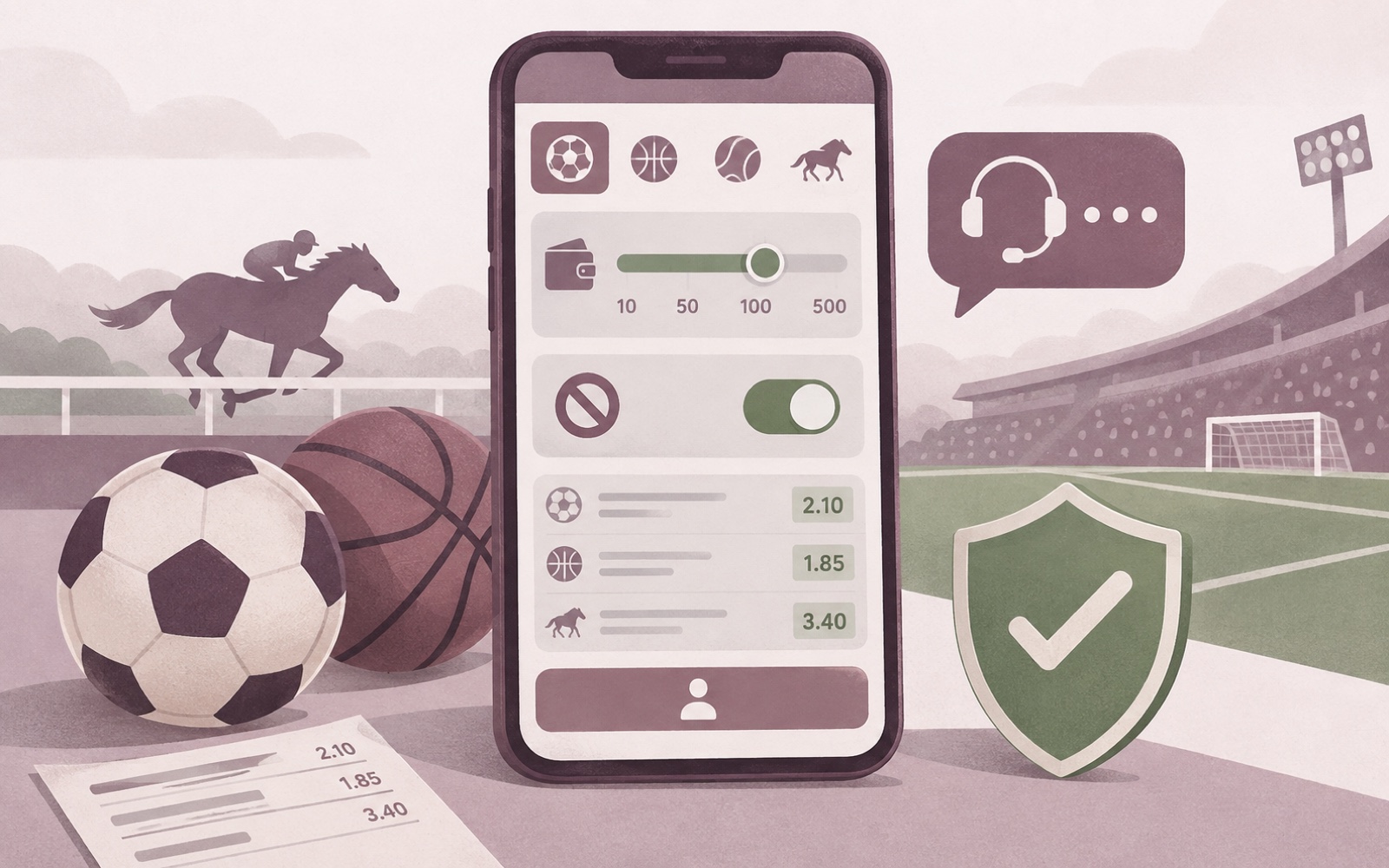
Most betting now happens on a phone, and an app changes the experience in ways worth naming. It is always in your pocket, it can log you in with a fingerprint in seconds, and it can send a message the moment a price moves. Handled carefully, that convenience is fine. Handled carelessly, it turns idle minutes into unplanned bets, which is why the way an app is set up matters as much as which one you choose.
This guide looks at apps and the mobile site side by side, at the safer-gambling tools every licensed app should offer, and at what to do when something goes wrong, from a first complaint to an independent decision. Throughout, the safe path is the same, which is to set your limits early, keep control of when you play, and reach out for free support on the GamCare helpline, 0808 8020 133, if betting stops feeling like fun.
01
Betting apps compared with the mobile site
An app and a betting site's mobile version do much the same job, but they feel different in the hand. An app is installed, so it launches instantly, often behind a fingerprint or face unlock, and it can keep you signed in. The mobile site runs in your browser, which means an extra step to reach it and no icon sitting on your home screen. That small amount of friction is not a flaw; for safer gambling it can be a quiet advantage, because anything that slows the reach for a bet gives you a moment to think.
The sharper difference is notifications. An app can send push messages about price boosts, live scores and free bets, and these are engineered to pull you back at moments you did not choose. Each one is a prompt to open the app and place a bet on impulse rather than intention. You do not have to accept them. In your phone settings you can switch notifications off entirely, and inside a good app you can turn off marketing messages, so the app opens when you decide to open it and stays quiet the rest of the time.
02
Using in-app safer gambling tools
On a UKGC-licensed app the safer-gambling tools are not extras, they are conditions of the licence, and they should sit a tap or two inside the account settings. Expect to find deposit limits you can set by day, week or month, time-outs that lock you out for anything from 24 hours to six weeks, reality-check reminders that tell you how long you have been playing, and self-exclusion that closes the account for a minimum of six months. All of it should be free and quick to switch on.
Two details protect you most. First, a decrease to a deposit limit must take effect immediately, while any increase has to be delayed and re-confirmed by you, so a limit cannot be raised on impulse during a losing run. Second, every licensed app should link openly to GAMSTOP, the free national scheme that blocks every licensed online site and app in a single registration for six months, one year or five years. Setting these up on the day you install an app is far easier than reaching for them mid-session.
A common example
Say you install an app on a Friday and decide £20 a week is your ceiling. Set that deposit limit straight away, switch off promotional push notifications, and turn on a reality check every 30 minutes. If a week later you feel the urge to raise the limit after a loss, the delay on increases gives you a cooling-off window, and a one-tap time-out is there if you would rather stop for a while. The tools only help if you turn them on before you need them.
03
Security, logins and staying safe on mobile
Because an app holds your money and your identity, treat its security seriously. Download only from the official Apple App Store or Google Play, not from a link in a message, and check the developer name matches the operator. Use a strong, unique password, turn on two-factor authentication if it is offered, and keep the biometric lock enabled so a lost phone does not mean an open account. Avoid placing bets over public wi-fi, and keep both the app and your phone's operating system updated.
Watch the account details as well as the app itself. A licensed operator confirms your identity and age, and it should let you deposit only from your own debit card, e-wallet or open banking, since using a credit card to gamble has been banned in Britain since April 2020. If an app asks you to pay by an unusual route, cannot be found on the Commission's public register, or markets itself as a way around GAMSTOP, close it. The table below is a quick set of checks before you trust any app with a deposit.
| What to check | Why it matters | Where |
|---|---|---|
| UKGC licence | Legal to serve UK, dispute route | Public register |
| Safer-gambling tools | Limits, time-outs, self-exclusion | Account settings |
| Payment terms | Debit only, clear withdrawal times | Banking page |
04
Customer support and response times
Good support is part of a safe experience, because most problems are far easier to fix while they are small. Look for more than one way to make contact, typically a live chat, an email address and often a help centre, and check the published hours before you need them. Live chat tends to answer quickest, though the first replies may be automated, and email suits anything where you want a written record.
Keep a record of every exchange from the start, including dates, times, names and screenshots, since a clear trail is what turns a vague grievance into a complaint that gets resolved. If a query touches your own gambling rather than a technical fault, remember that operator support is not counselling, and free, confidential help is always available from services such as GamCare regardless of how the operator responds.
Key points
- Switch off push notifications and marketing messages so the app opens when you choose, not when it wants your attention.
- Set deposit limits, reality checks and, if needed, self-exclusion or GAMSTOP the day you install an app, while you feel calm.
- Complain to the operator first, then a UKGC-approved ADR provider such as IBAS; the Gambling Commission does not settle individual disputes.
05
How to make a complaint that gets heard
If something goes wrong, the first and most important step is to complain to the operator directly. Put it in writing through the app's complaints process or by email, quote your account details and the relevant dates, describe plainly what happened, and say what you want put right. Stay factual and keep copies of everything. A licensed operator must have a complaints procedure and should give you a clear final response, usually within eight weeks.
Give the operator a fair chance to resolve it, but do not let it drift. If the reply does not settle the matter, or the eight weeks pass without a final answer, you have the right to take the complaint further at no cost to you. Knowing that route exists before you start makes it easier to stay calm and businesslike in those first messages, which is usually what gets a complaint taken seriously.
A common example
Suppose a withdrawal you requested has not arrived and the timescale the app promised has passed. Message support, keep the chat transcript, and if that does not resolve it, submit a formal written complaint asking for a final response and a clear reason for the delay. If the operator's final position still does not satisfy you, that is the point to move to independent alternative dispute resolution, described next.
06
Alternative dispute resolution and IBAS
When you and the operator cannot agree, a UKGC-licensed operator must give you access to an approved alternative dispute resolution, or ADR, provider. ADR is a free, independent service that reviews the evidence from both sides and reaches a decision, without you needing to go to court. The best known provider for betting is the Independent Betting Adjudication Service, or IBAS, and operators will tell you which approved provider covers them. Because approved providers can change, confirm the current one from the operator's terms or the Commission's information rather than assuming.
To use ADR you normally need the operator's final response, or proof that eight weeks have passed, along with your records of the dispute. The provider's decision is designed to be a fair, evidence-based resolution. It is worth stressing what ADR is not, which is a route to challenge the outcome of a fairly settled bet you simply lost; it exists for genuine disputes about how you were treated, not for buyer's remorse.
07
What the regulator does and the forthcoming ombudsman
It helps to be clear about who does what. The Gambling Commission licenses operators, sets the rules they must follow and can take enforcement action, but it does not adjudicate individual customer disputes or get your money back. Reporting a problem to the Commission is still valuable, because your report can inform action against an operator that is breaking the rules, even though it will not resolve your personal case. For that, the complaint-then-ADR route above is the one to follow.
Change is coming to this landscape. The government's 2023 gambling White Paper proposed a new Gambling Ombudsman to handle consumer complaints about operators in a single, clearer place, and work on it is progressing. Once established, it is expected to give customers a more straightforward path to redress. Until then, the steps here remain the route to follow, and if any of this is causing real stress, the priority is your wellbeing. You can find guidance and self-help at BeGambleAware and talk to a trained adviser free, day or night, on the GamCare helpline, 0808 8020 133.
Related reading on this site
- How to choose a betting site in the UK
- How to check a betting site's UKGC licence
- Understanding odds, markets and value
- Deposits, withdrawals and the credit-card ban
- Safer gambling tools and GAMSTOP
- Warning signs of an unsafe betting site
- Bet types, accumulators and cash out
How we check our facts
We describe complaints and dispute routes against licensing guidance from the Gambling Commission, the 2023 gambling White Paper published on gov.uk, and support information from GamCare. Approved ADR providers can change, so we name IBAS as an example and advise readers to confirm the current provider. Last checked 25 September 2026.

Frequently asked questions
Should I turn off betting app notifications?
For safer gambling, yes. Push notifications about odds boosts, live prices and free bets are designed to pull you back into the app at moments you did not choose, which encourages impulsive play. Turning them off in your phone settings puts you back in control of when you open the app. Many apps also let you switch off marketing messages, and you can opt out of gambling advertising through registers such as those signposted by GamCare. If an app makes notifications hard to silence, treat that as a poor sign.
Which safer gambling tools should a good betting app include?
On a UKGC-licensed app you should be able to set a deposit limit, take a time-out from 24 hours up to six weeks, set reality-check reminders and use self-exclusion, all from the account settings and free of charge. A decrease to a deposit limit should apply immediately, while an increase must be delayed and re-confirmed. The app should also link openly to GAMSTOP, the free scheme that blocks every licensed site and app in one step. If these tools are buried or missing, choose a different operator.
How do I complain about a betting operator and who can help if it is not resolved?
Complain to the operator first, in writing, quoting your account, the dates and what you want put right, and keep copies. A licensed operator must respond and give you a final position, usually within eight weeks. If you are still unhappy, you can take a free complaint to a UKGC-approved alternative dispute resolution provider, such as IBAS. The Gambling Commission does not settle individual disputes or recover money for customers. A forthcoming Gambling Ombudsman, proposed in the 2023 White Paper, is expected to handle complaints in future.
Will the Gambling Commission get my money back if an operator treats me unfairly?
No. The Gambling Commission licenses and regulates operators, and it acts on the information you report, but it does not settle individual disputes or return money to you. For your own case, complain to the operator first and then use a UKGC-approved alternative dispute resolution provider such as IBAS, which can issue a decision at no cost to you. If your complaint is really about how much you are spending, help is free on the GamCare helpline, 0808 8020 133.